


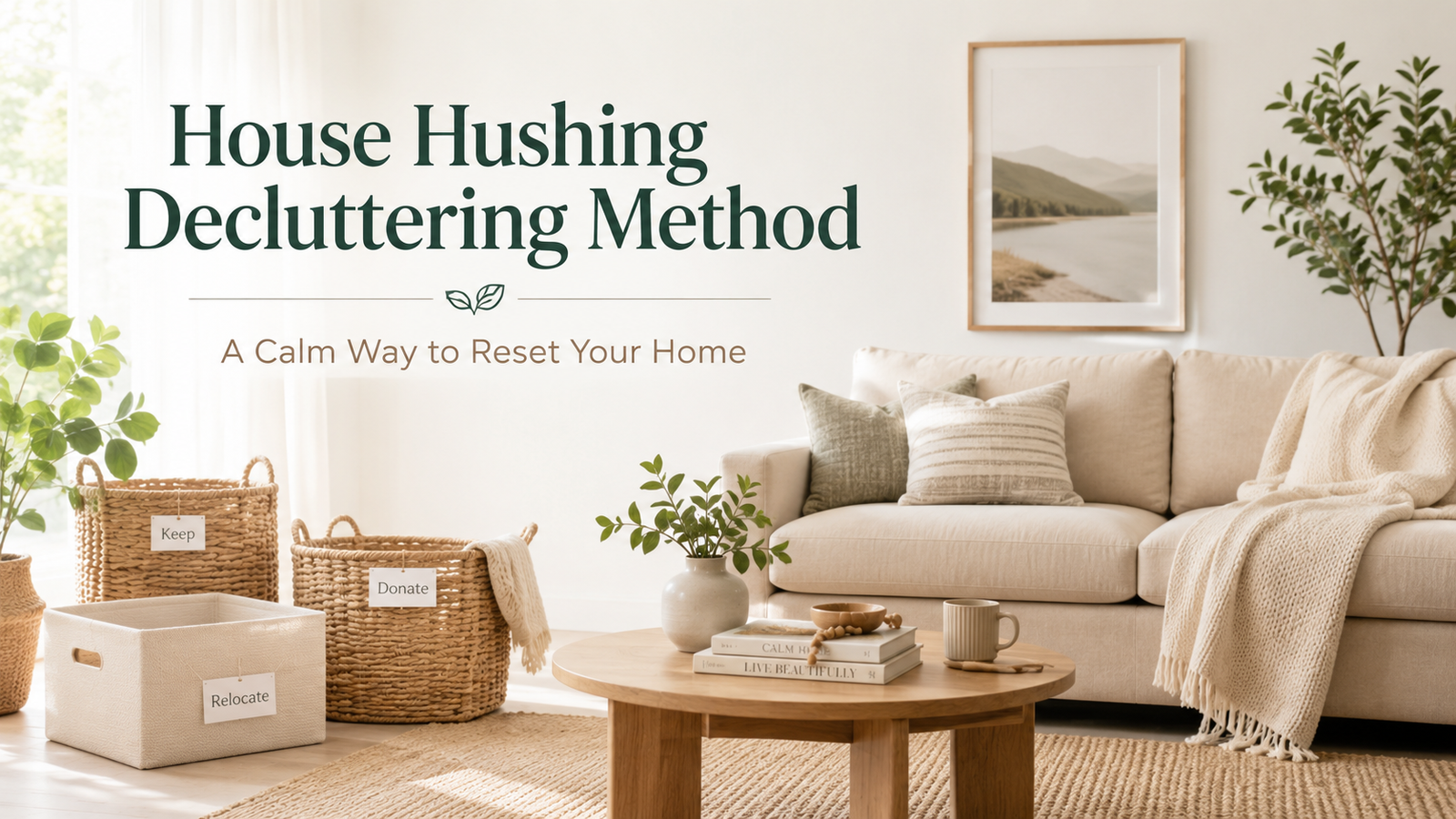
The house hushing decluttering method is a gentle home-reset strategy that helps reduce visual clutter without forcing you to make immediate decisions about every object you own.
Instead of beginning with donation bags and throwing things away, you temporarily remove nonessential items from a room. You then live with the quieter space for approximately 24 to 48 hours before returning only the belongings that are useful, meaningful, or visually appropriate.
This pause makes the house hushing decluttering method different from many traditional organizing systems. It allows you to experience the room first and evaluate individual objects afterward.
The method can work in living rooms, bedrooms, kitchens, bathrooms, home offices, entryways, guest rooms, studio apartments, and shared family spaces. You can apply it to an entire room or start with one bookshelf, countertop, desk, drawer, or coffee table.
Better Homes & Gardens describes house hushing as a calming process involving the removal, refreshing, and intentional resetting of a space.
Learn more about the house hushing trend from Better Homes & Gardens.
For more home organization and decorating inspiration, explore our latest home decor news and ideas.
Table of Contents
What Is the House Hushing Decluttering Method?
The house hushing decluttering method involves temporarily removing unnecessary objects from a room so you can experience the space in a simpler and quieter state.
You do not need to donate, discard, or permanently remove everything immediately. The objects are placed inside a temporary holding area while you evaluate how the room looks, feels, and functions without them.
After approximately 24 to 48 hours, you begin returning items intentionally. Functional objects usually return first, followed by a limited number of decorative and sentimental pieces.
The process can help answer questions such as:
- Which objects do I actually use?
- Which decorations make the room feel better?
- Which belongings create unnecessary visual noise?
- Which items belong in another room?
- Which objects can be stored, donated, recycled, or discarded?
- How much empty space feels comfortable?
- Which surfaces need to remain functional?
The Washington Post has also presented house hushing as a way to temporarily reduce visual noise before making permanent decisions about belongings.
Read The Washington Post guide to house hushing.
Why the House Hushing Decluttering Method Works
The house hushing decluttering method works because it separates removing an object from the pressure of deciding its permanent future.
Traditional decluttering often asks you to hold an item and immediately decide whether to keep, donate, sell, recycle, or discard it. That can become emotionally exhausting when a room contains sentimental belongings, gifts, unfinished projects, books, photographs, decorative accessories, and objects connected to past routines.
House hushing creates a temporary pause. Your belongings remain available, but they are removed from the visible space. You can therefore evaluate the room before evaluating every individual possession.
A quieter room may help you notice:
- How much open space you prefer
- Which surfaces are difficult to clean
- Which colors make the room feel calm
- Which objects were visually distracting
- Which items you genuinely use every day
- Which decorations contribute personality
- Which belongings are present only because they have always been there
The goal of the house hushing decluttering method is not to create a completely empty or impersonal home. The goal is to understand how much furniture, decoration, storage, and visual detail feels comfortable for your household.
1. Choose One Manageable Space
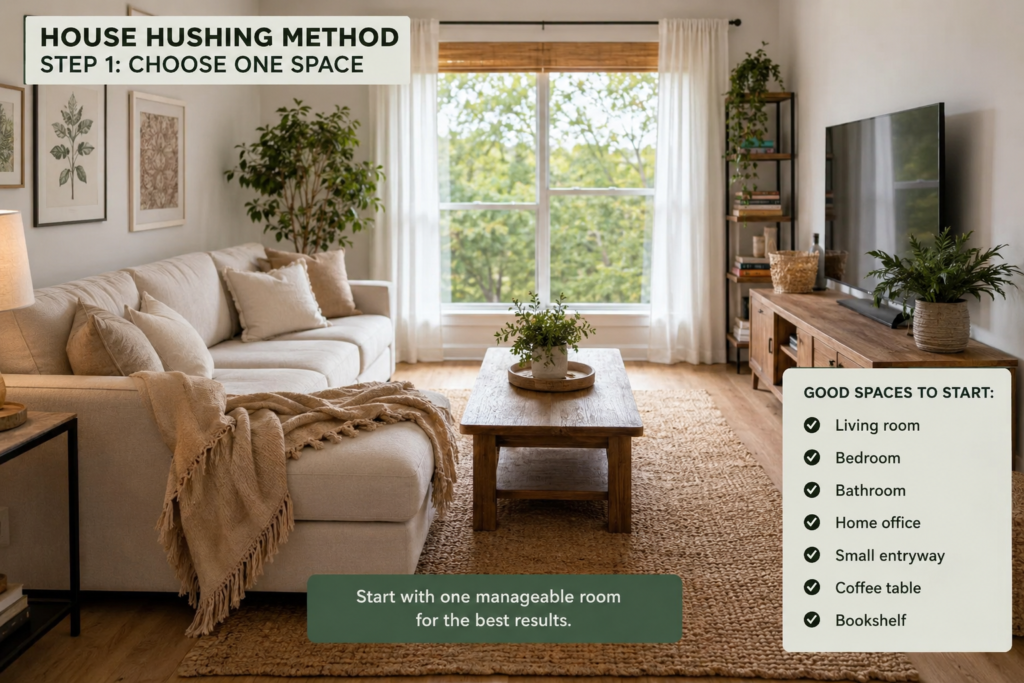
Do not start with the largest or most cluttered part of the home. Your first house-hushing project should feel manageable and provide visible progress.
Good starting places include:
- A bedside table
- A living room coffee table
- A bathroom counter
- A kitchen cabinet
- A home office desk
- A small entryway
- A guest bedroom
- One bookshelf
- A dining room sideboard
The house hushing decluttering method is easier to understand when you begin with one clearly defined area. Starting with several rooms may create a large temporary pile and make the project feel more stressful.
2. Create a Temporary Holding Zone
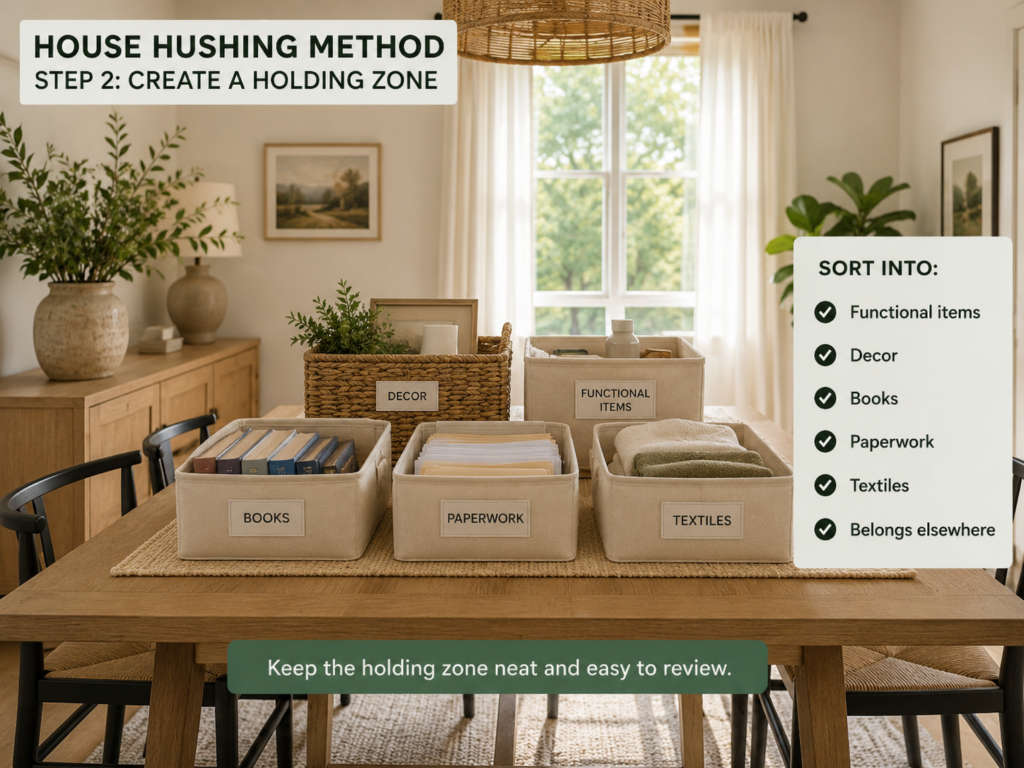
Before removing anything, select a temporary place where belongings can remain during the 24-to-48-hour waiting period.
Your holding zone could be:
- A guest bedroom
- An unused dining table
- A folding table
- A clear section of a bedroom
- Several labeled storage boxes
- A designated area in a hallway
Separate the objects into basic categories:
- Functional items
- Decorative accessories
- Paperwork
- Books
- Textiles
- Items that belong elsewhere
- Possible donations
- Undecided items
The temporary zone should remain organized. The house hushing decluttering method should not simply move an uncontrolled pile from one room into another.
3. Photograph the Room Before You Begin
Take several photographs before removing objects. Capture wide views of the room and close-up images of shelves, counters, tables, and storage areas.
Photographs often reveal clutter that becomes difficult to notice when you see the same room every day.
Look for:
- Overfilled surfaces
- Too many small decorations
- Duplicate objects
- Items blocking useful space
- Uncoordinated colors
- Furniture that interrupts movement
- Objects without a clear purpose or location
After finishing the house hushing decluttering method, compare the before-and-after photographs. This will help you identify which changes produced the greatest visual and practical improvement.
4. Remove Nonessential Objects
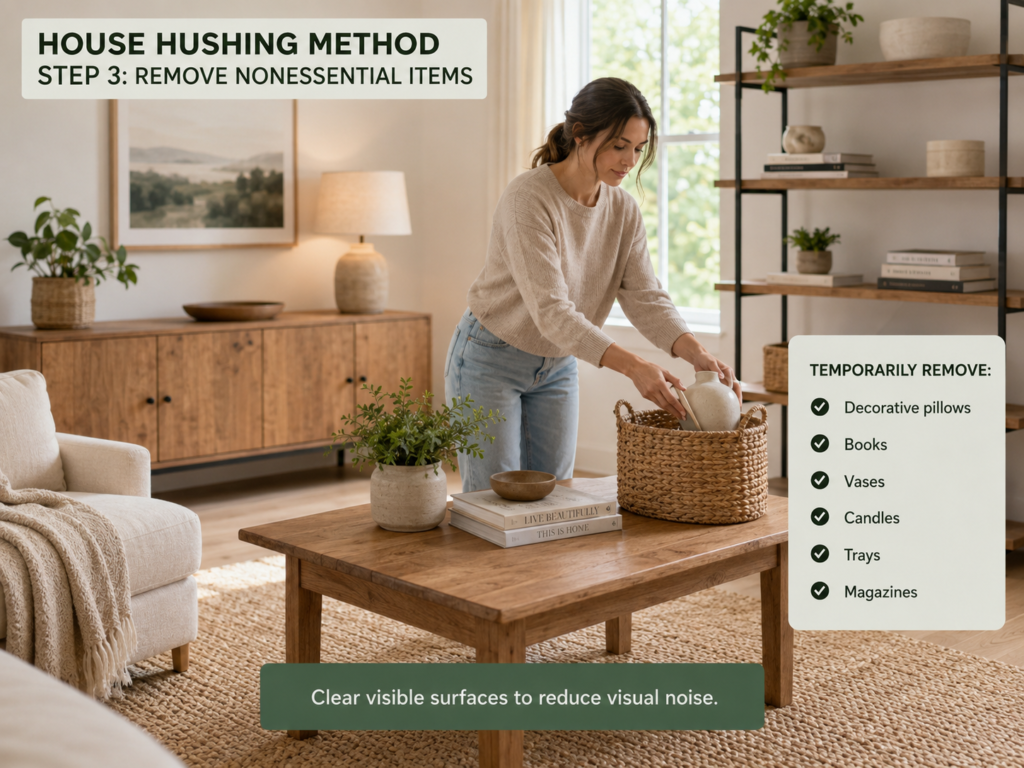
The main step of the house hushing decluttering method is temporarily clearing away objects that are not essential to the room’s immediate function.
In a living room, temporarily remove:
- Decorative pillows
- Extra throws
- Books
- Trays
- Candles
- Vases
- Small sculptures
- Magazines
- Unused baskets
- Seasonal decorations
Do not make permanent decisions while removing the objects. The goal is to create a quieter room, not to complete every donation decision immediately.
5. Keep Essential Furniture in Place
You do not need to empty the room completely. Keep the main furniture and equipment required for everyday use.
For a living room, this may include:
- Sofa
- Chairs
- Coffee table
- TV console
- Main lamps
- Window treatments
For a bedroom, keep the bed, nightstands, essential bedding, main lamps, and necessary storage furniture.
The house hushing decluttering method focuses mainly on reducing visual noise. The room should remain functional throughout the process.
6. Clean the Newly Empty Surfaces
Once the smaller objects are removed, clean every newly exposed surface before returning anything.
Clean:
- Shelves
- Tables
- Countertops
- Mirrors
- Windowsills
- Baseboards
- Floors
- Cabinet interiors
- Storage baskets
An empty and clean surface creates a stronger sense of reset. It also makes it easier to judge whether a decorative object truly deserves to return.
For practical cleaning, repair, and organization guidance, visit our home improvement guides.
7. Live with the Quieter Room for 24 to 48 Hours
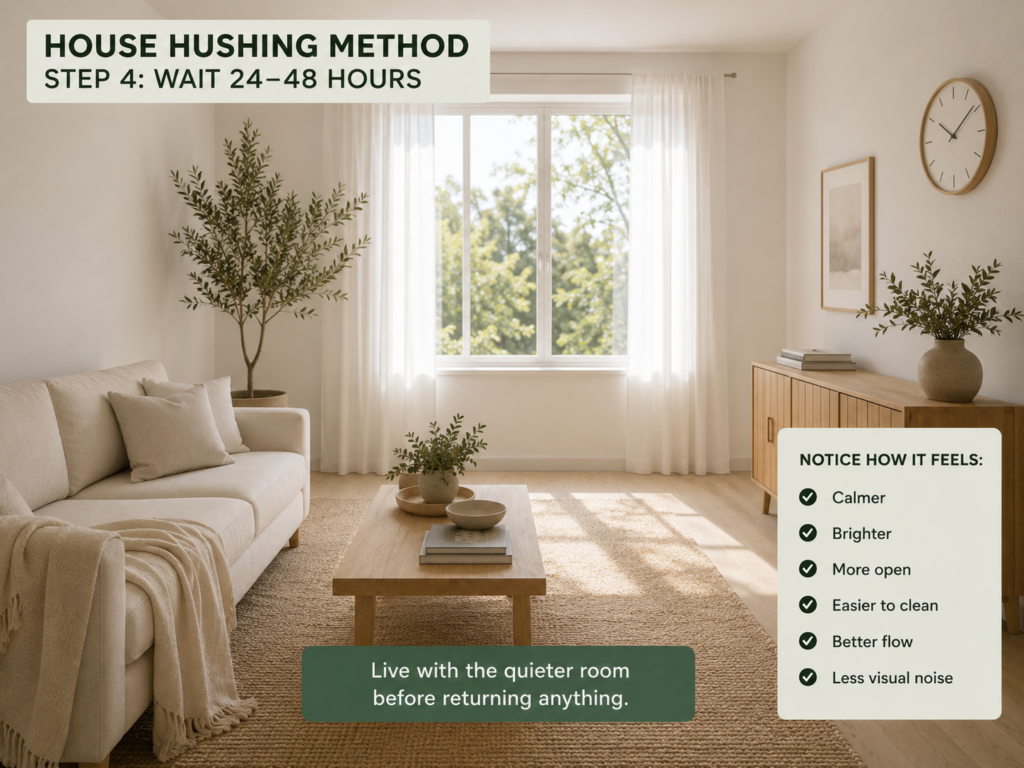
Do not immediately return everything. The waiting period is one of the most important elements of the house hushing decluttering method.
Use the room normally for at least one full day. Observe the space during the morning, afternoon, and evening.
Ask yourself:
- Does the room feel calmer?
- Is it easier to clean?
- Can I move through it more comfortably?
- Are useful surfaces easier to access?
- Which objects do I genuinely miss?
- Which objects have I forgotten completely?
- Does the room feel too empty?
Real Simple describes house hushing as a short-term room reset that helps people reintroduce belongings more thoughtfully.
Read Real Simple’s explanation of house hushing.
8. Notice How the Room Makes You Feel
Organization is not only about counting possessions. It is also about how easily a room supports everyday activities.
During the waiting period, notice whether the room feels:
- Calmer
- Brighter
- Larger
- Easier to use
- More comfortable
- Less personal
- Too empty
A quieter room does not need to become a minimalist room. The house hushing decluttering method helps you discover the amount of visual detail that feels comfortable for you.
9. Return Functional Items First
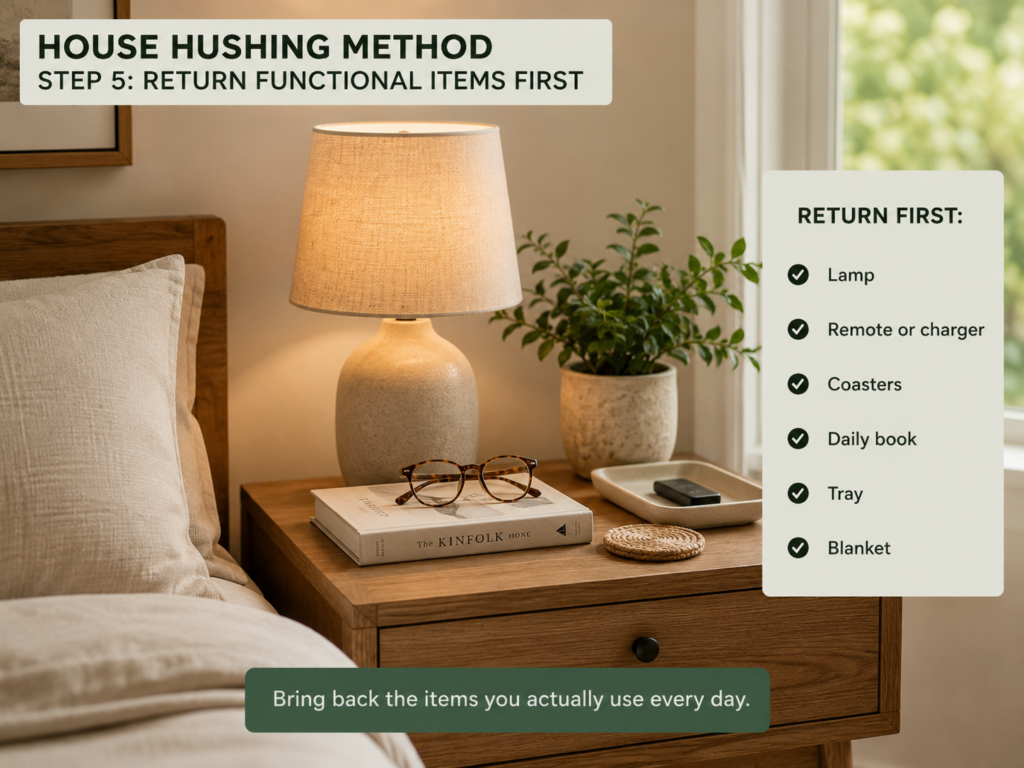
After the waiting period, begin by returning items that serve a regular practical purpose.
These may include:
- A reading lamp
- Remote controls
- Coasters
- Frequently used books
- A storage tray
- A blanket
- A charging station
- Daily toiletries
- Kitchen utensils
Place each item where it is easy to use and easy to return after use.
If an item has no logical home, consider using an organizer rather than placing it randomly on a visible table or countertop.
10. Add Decorative Objects Slowly
After returning functional items, begin adding decorative objects one at a time.
Do not automatically recreate the old arrangement. Pause after adding each object and decide whether it improves the room.
Prioritize:
- Meaningful photographs
- Favorite artwork
- Useful decorative trays
- Healthy plants
- Objects connected to memories
- Pieces supporting the color palette
- Items with visual or textural contrast
The house hushing decluttering method often makes decorative items feel more important because each piece receives more visual space.
Three carefully selected objects may create more impact than ten unrelated accessories crowded onto the same shelf.
11. Remove Duplicate and Unused Items
As you review the temporary holding area, identify unnecessary duplicates and belongings that are rarely used.
Common duplicates include:
- Decorative trays
- Vases
- Blankets
- Candles
- Storage baskets
- Kitchen utensils
- Desk supplies
- Cleaning products
- Charging cables
Keep the version you use most or the item that best fits the room. Donate, recycle, relocate, or responsibly discard the others according to their condition.
12. Use Attractive Storage for Everyday Essentials
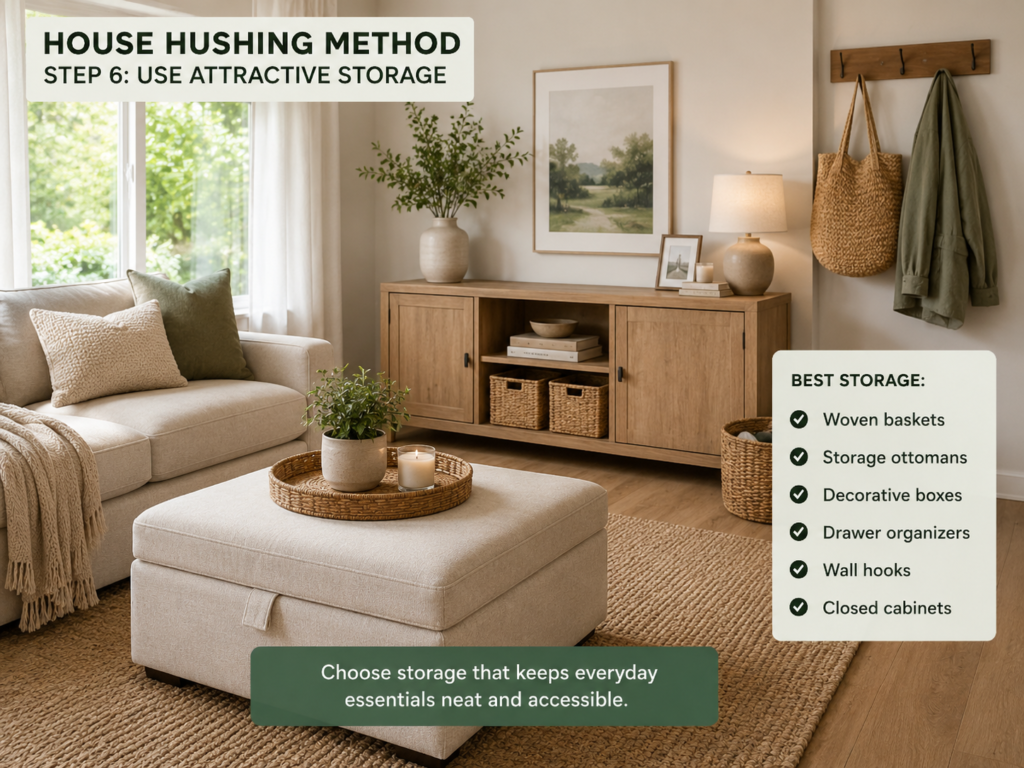
Not every object can disappear. Everyday essentials should remain accessible, but they can be grouped inside storage that supports the design of the room.
Useful storage options include:
- Woven baskets
- Storage ottomans
- Decorative boxes
- Wood trays
- Closed cabinets
- Drawer organizers
- Wall hooks
- Rolling carts
- Under-bed containers
Do not buy organizers before completing the main house hushing decluttering method. You may discover that you need fewer baskets, cabinets, and shelves after removing unnecessary possessions.
For storage furniture and small-space solutions, browse our furniture ideas and reviews.
13. Apply the House Hushing Decluttering Method to the Living Room
The living room is an ideal place to test the house hushing decluttering method because it often contains entertainment equipment, textiles, books, functional objects, and decorative accessories.
Temporarily remove objects from:
- The coffee table
- The TV console
- Side tables
- Bookshelves
- The sofa
- Window ledges
- The fireplace mantel
Return the remote controls, coasters, lamp, and other useful objects first. Then introduce a limited number of books, pillows, plants, photographs, and accessories.
Leave some surfaces partially empty. Empty space makes the remaining items easier to appreciate and makes the room easier to maintain.
14. Apply House Hushing to the Bedroom
A bedroom should support sleep, dressing, relaxation, and personal routines. The house hushing decluttering method can prevent the bedroom from becoming an overflow storage area.
Temporarily remove:
- Excess decorative pillows
- Clothes placed on chairs
- Unused beauty products
- Books that are not being read
- Old receipts
- Unnecessary bedside decor
- Exercise equipment stored visibly
- Items placed on the floor
Keep the bed, essential bedding, lamps, alarm clock, water glass, and products used during the daily routine.
When returning decorative objects, leave enough space on the nightstand for practical items such as a phone, glasses, book, or glass of water.
15. Use the House Hushing Decluttering Method in the Kitchen
Kitchen counters often collect appliances, containers, mail, grocery bags, utensils, and decorative accessories.
Temporarily relocate:
- Appliances used less than once a week
- Duplicate utensil holders
- Unused cutting boards
- Several decorative bowls
- Mail and paperwork
- Empty containers
- Excess spices near the stove
- Products without permanent storage
Return frequently used items first. A coffee maker, kettle, fruit bowl, or knife block may deserve visible space when it is used every day.
The best kitchen version of the house hushing decluttering method creates clear preparation areas without making essential tools difficult to access.
16. Hush the Bathroom
Remove products from the bathroom counter, shower, bathtub, windowsill, and open shelving.
Review:
- Expired products
- Duplicate toiletries
- Empty bottles
- Unused samples
- Old towels
- Excess decorative containers
- Cleaning products stored visibly
Return only the products used during daily routines. Store backup toiletries, spare towels, and occasional products in baskets, drawers, cabinets, or labeled containers.
17. Reset the Home Office
A home office may need a stricter approach because visual clutter can compete with concentration and productivity.
Temporarily remove:
- Old paperwork
- Unused notebooks
- Duplicate pens
- Empty packaging
- Decorations covering the desk
- Books unrelated to current work
- Unidentified cables
- Unfinished projects that belong in storage
Return the computer, lamp, notebook, charging station, and daily tools first.
Daily items should remain within reach. Weekly supplies can go into drawers, while occasional materials should move into closed cabinets or labeled boxes.
18. Use House Hushing in a Small Apartment
The house hushing decluttering method is especially valuable in small apartments because visual clutter becomes noticeable quickly when one room supports several different activities.
In a studio or compact apartment:
- Begin with the entryway or coffee table
- Use vertical storage
- Keep walkways open
- Choose furniture with hidden storage
- Limit decorations on small surfaces
- Use trays to group daily essentials
- Store seasonal items out of sight
- Keep the dining or work table functional
Avoid buying more organizers before evaluating what you own. Removing unnecessary items may solve the storage problem without requiring additional furniture.
House Hushing in Different U.S. Cities
New York and Boston Apartments
Focus on vertical storage, entryway clutter, coffee tables, desks, visible clothing storage, and multifunctional furniture. Small apartments benefit from partially empty surfaces and clear walkways.
Los Angeles and San Diego Homes
Apply the method to indoor-outdoor spaces, patio accessories, open shelving, plants, entry storage, and transitional living areas.
Miami and Houston Homes
Review moisture-sensitive textiles, bathroom products, outdoor accessories, lightweight seasonal decorations, and items collecting near entrances.
Dallas and Austin Homes
Focus on open-plan living areas, kitchen counters, entertainment spaces, home offices, and storage used when hosting friends and family.
Chicago and Seattle Homes
Review seasonal clothing, blankets, jackets, footwear, umbrellas, books, and lighting accessories that collect around entryways and living rooms.
The same house hushing decluttering method works in different locations, but the types of clutter may vary according to climate, house size, and lifestyle.
19. Follow a Seven-Day House Hushing Decluttering Method Plan
Day 1: Select the Room
Choose one room or one clearly defined zone. Take photographs and identify the surfaces creating the most visual noise.
Day 2: Prepare the Holding Area
Set up labeled boxes or a temporary table for functional items, decorations, textiles, paperwork, donations, and undecided belongings.
Day 3: Remove Nonessential Items
Clear visible surfaces and smaller accessories while keeping the furniture necessary for everyday use.
Day 4: Clean and Observe
Clean the room thoroughly and spend time in the quieter space without immediately returning objects.
Day 5: Return Functional Items
Bring back the belongings used daily and give each one a logical location.
Day 6: Return Selected Decorative Pieces
Add meaningful and decorative objects slowly. Stop before every surface becomes full.
Day 7: Review the Holding Area
Relocate objects that belong elsewhere. Store seasonal belongings, donate usable products, recycle appropriate materials, and discard damaged items responsibly.
This seven-day version of the house hushing decluttering method prevents the project from feeling rushed and gives you more time to evaluate the space.
20. Maintain the Reset with a Weekly Hush
You do not need to repeat the complete process every week. Use a shorter routine to stop visual clutter from returning.
Once a week:
- Clear one main surface
- Return misplaced objects
- Remove empty packaging and trash
- Fold blankets and arrange pillows
- Review one drawer or basket
- Donate one unused item when appropriate
A fifteen-minute reset can preserve the benefits of the house hushing decluttering method without requiring another complete room transformation.
House Hushing vs. Traditional Decluttering
Traditional Decluttering
Traditional decluttering generally begins with the object. You pick up an item and decide immediately whether it should remain in the home.
This approach can work well when:
- The room contains obvious trash
- There are many duplicates
- You are preparing to move
- You need fast results
- A storage area is physically overcrowded
House Hushing
House hushing begins with the experience of the room. You remove multiple objects, observe the quieter space, and then decide what deserves to return.
This approach may work better when:
- You feel emotionally attached to many objects
- The room is functional but visually busy
- You are unsure which decorations to remove
- You want a calmer home without extreme minimalism
- You prefer slower and more thoughtful decisions
You can combine both strategies. Use the house hushing decluttering method to reset visible spaces, then use traditional sorting methods for drawers, closets, garages, cabinets, and storage rooms.
Storage Products to Consider After House Hushing
After reducing unnecessary belongings, you may still need practical storage for the items that remain.
Useful products include:
- Storage ottomans
- Woven baskets
- Closed bookcases
- Under-bed boxes
- Drawer dividers
- Decorative document boxes
- Cable organizers
- Wall hooks
- Entryway benches
- Lift-top coffee tables
- Rolling carts
- Bathroom cabinet organizers
The best storage system should match the habits of the household. An open basket may be suitable for blankets used every evening, while closed cabinets may be better for paperwork, electronics, toiletries, or visually distracting supplies.
For product inspiration, browse our home furniture and decor product reviews.
21. Common House Hushing Decluttering Method Mistakes
Removing Too Much at Once
Starting with several rooms can create an overwhelming holding area. Begin with one room, shelf, or visible surface.
Skipping the Waiting Period
The 24-to-48-hour pause helps you understand how the quieter room feels before returning objects.
Turning the Holding Area into Permanent Clutter
Set a specific date to review everything that has been removed.
Buying Organizers Too Early
Declutter before shopping. You may discover that you need fewer boxes, baskets, cabinets, and shelves than expected.
Returning Everything Automatically
Each object should earn its place through usefulness, meaning, or visual value.
Trying to Create a Completely Empty Home
The house hushing decluttering method is not about removing personality. It is about selecting possessions more intentionally.
Ignoring Other Household Members
Do not remove another person’s belongings permanently without discussing the decision with them.
Final Thoughts
The house hushing decluttering method provides a calm and flexible alternative to fast, high-pressure decluttering.
Instead of forcing immediate decisions, it gives you time to experience a room with fewer objects. This makes it easier to identify what is useful, meaningful, visually attractive, and responsible for unnecessary clutter.
Start with a manageable room or one visible surface. Create a holding area, remove nonessential items, clean the space, and wait for approximately 24 to 48 hours.
Return functional belongings first. Then add decorative and sentimental pieces slowly, leaving enough empty space for the room to remain comfortable and easy to maintain.
The house hushing decluttering method works best when the final room still reflects your personality while becoming easier to clean, organize, and enjoy.
For more decorating and organization inspiration, visit the Decoriva Home homepage.
Frequently Asked Questions
What is the house hushing decluttering method?
The house hushing decluttering method involves temporarily removing nonessential items from a room, living with the quieter space for 24 to 48 hours, and returning only useful, meaningful, or visually appropriate objects.
How long should I hush a room?
Approximately 24 to 48 hours is usually enough to experience how the room feels without its normal visual clutter.
Do I need to remove all the furniture?
No. Keep essential furniture and equipment in place. Focus mainly on smaller objects, decorations, textiles, and belongings covering visible surfaces.
What room should I hush first?
Start with a manageable room such as a living room, guest bedroom, home office, bathroom, or small entryway.
Does house hushing require throwing things away?
No. Items are initially placed inside a temporary holding zone. You can later return, relocate, store, donate, recycle, sell, or discard them.
Is the house hushing decluttering method good for small apartments?
Yes. It can reduce visual clutter, improve walkways, and help apartment residents decide which possessions deserve limited visible space.
Can I hush only one shelf or table?
Yes. A bookshelf, bathroom counter, desk, kitchen cabinet, dresser, or coffee table can be treated as a complete mini-project.
How often should I repeat the method?
A full room reset may be useful once or twice each year. Smaller surface resets can be completed weekly or monthly.
What storage products work well after house hushing?
Useful options include woven baskets, storage ottomans, decorative boxes, trays, drawer dividers, closed cabinets, rolling carts, and wall hooks.
What alt text should I use for the featured image?
Use the exact Focus Keyword:
house hushing decluttering method
[…] can also use the house hushing decluttering method to reduce visual clutter before purchasing new kitchen organizers or […]
[…] choose only the solutions that address a real problem. If the area already feels crowded, use the house hushing decluttering method before adding more […]