


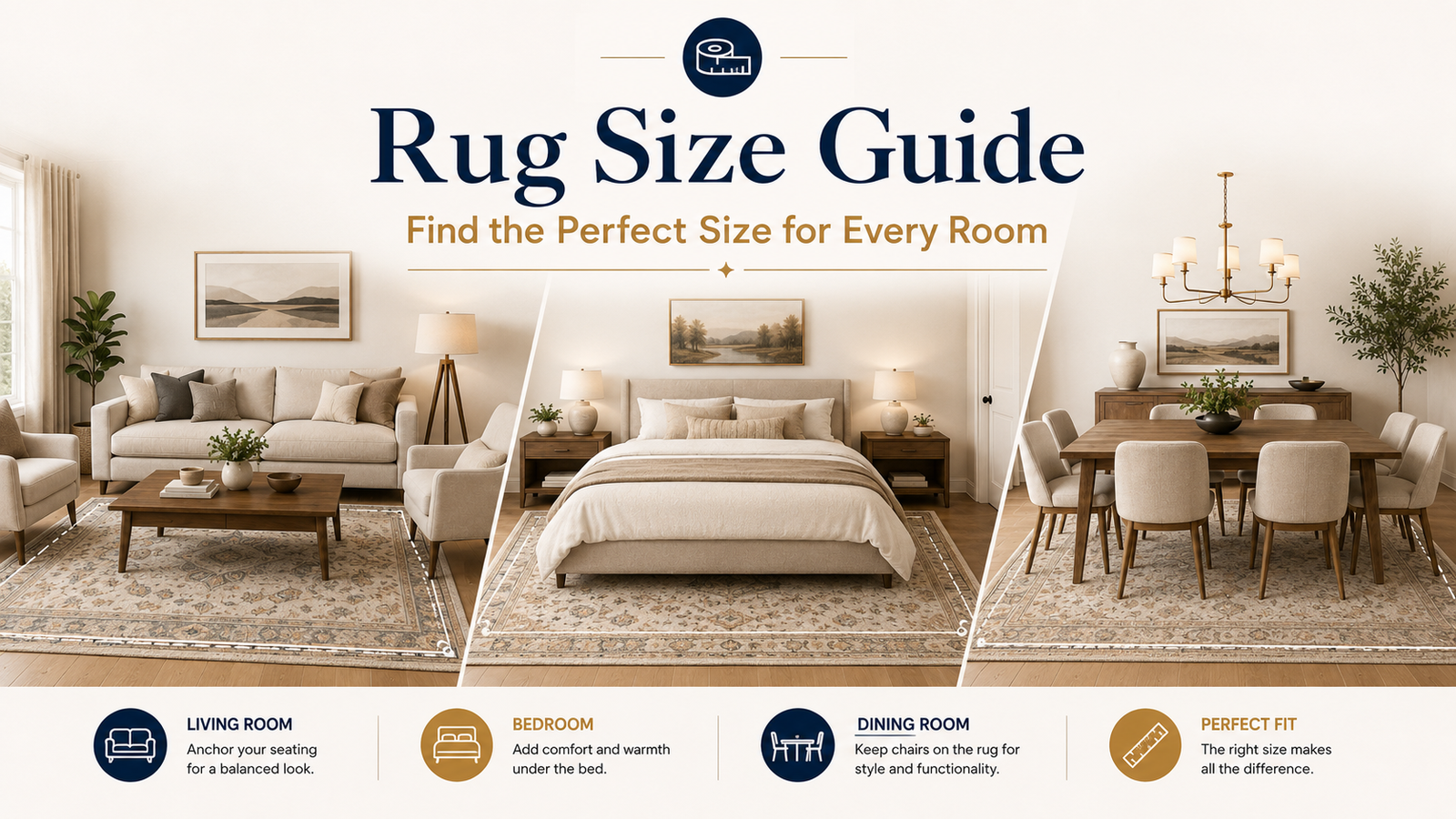
A reliable rug size guide can help you avoid one of the most common interior design mistakes: choosing a rug that is too small for the room. The right rug size connects your furniture, defines the space, and makes the room feel balanced and professionally designed.
This complete rug size guide includes practical measurements for living rooms, bedrooms, dining rooms, hallways, entryways, home offices, and open-concept spaces.
Whether you are decorating a new home or replacing an old rug, this rug size guide will help you choose dimensions that fit your furniture, room layout, and decorating style.
Table of Contents
Rug Size Guide: Quick Reference Chart
Use this rug size guide chart as a starting point before measuring your room and furniture.
| Room | Small Space | Medium Space | Large Space |
|---|---|---|---|
| Living Room | 5 × 7 ft | 8 × 10 ft | 9 × 12 ft |
| Bedroom | 5 × 7 ft | 8 × 10 ft | 9 × 12 ft |
| Dining Room | 6 × 9 ft | 8 × 10 ft | 9 × 12 ft |
| Home Office | 4 × 6 ft | 5 × 7 ft | 6 × 9 ft |
| Entryway | 3 × 5 ft | 4 × 6 ft | 5 × 7 ft |
| Hallway | 2 × 6 ft | 2 × 8 ft | 3 × 10 ft |
Use this rug size guide as a quick reference whenever you compare standard rug dimensions online or in a furniture store.
1. Measure the Room and Furniture
Before buying a rug, measure both the room and the furniture arrangement.
Do not measure only the empty floor. The rug must work with the sofa, chairs, bed, dining table, desk, or other furniture in the room.
Follow these steps:
- Measure the room’s length and width.
- Measure the full furniture arrangement.
- Mark the possible rug outline with painter’s tape.
- Check door and cabinet clearance.
- Leave some visible flooring around the rug.
- Confirm that walking paths remain open.
A practical rug size guide should always be combined with accurate measurements.
Painter’s tape is especially useful because it lets you visualize the rug dimensions before placing an order.
For more placement examples, compare your measurements with The Home Depot’s rug sizing guide.
2. Living Room Rug Size Guide
A living room rug should connect the sofa, chairs, coffee table, and other furniture into one defined seating area.
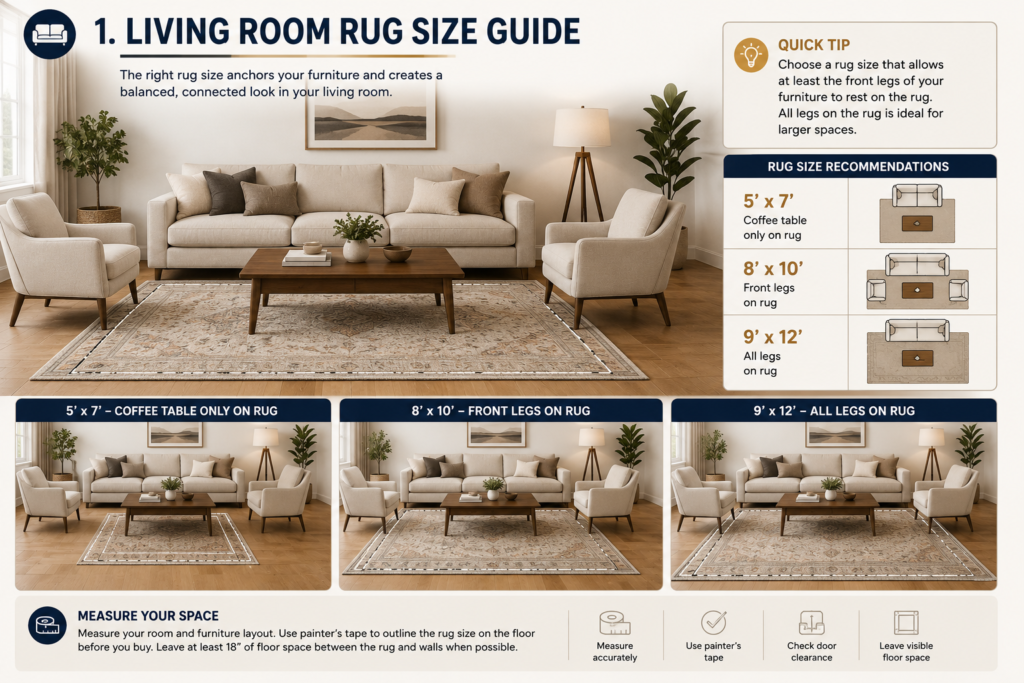
This living room rug size guide can help you decide whether all furniture legs or only the front legs should sit on the rug.
5 × 7 Foot Living Room Rug
A 5 × 7 ft rug can work in a small apartment or compact living room.
With this layout, the coffee table usually sits in the center of the rug while the sofa and chairs remain outside it.
This option can work when floor space is limited. However, avoid choosing a rug that is only slightly larger than the coffee table.
A rug that is too small can make the room feel disconnected and unfinished.
8 × 10 Foot Living Room Rug
An 8 × 10 ft rug is one of the most versatile choices for a medium-sized living room.
Place the front legs of the sofa and accent chairs on the rug while leaving the back legs on the floor.
This arrangement creates a connected seating area without requiring an oversized rug.
An 8 × 10 rug often works well with:
- A standard three-seat sofa
- A small sectional sofa
- Two accent chairs
- A medium-sized coffee table
- A narrow console table
9 × 12 Foot Living Room Rug
A 9 × 12 ft rug is usually suitable for a large living room or open-plan space.
Place all the main furniture legs on the rug for a luxurious and cohesive appearance.
The rug should extend beyond the sofa and chairs so the furniture does not look crowded near the rug’s edges.
Best Living Room Rug Placement
This rug size guide recommends three main placement styles.
All furniture legs on the rug:
Best for large living rooms and open floor plans.
Front furniture legs on the rug:
Best for most medium-sized living rooms.
Coffee table only on the rug:
Suitable for small spaces, provided the rug still feels proportional to the seating area.
3. Bedroom Rug Size Guide
A bedroom rug should provide warmth, comfort, and a soft surface around the bed.
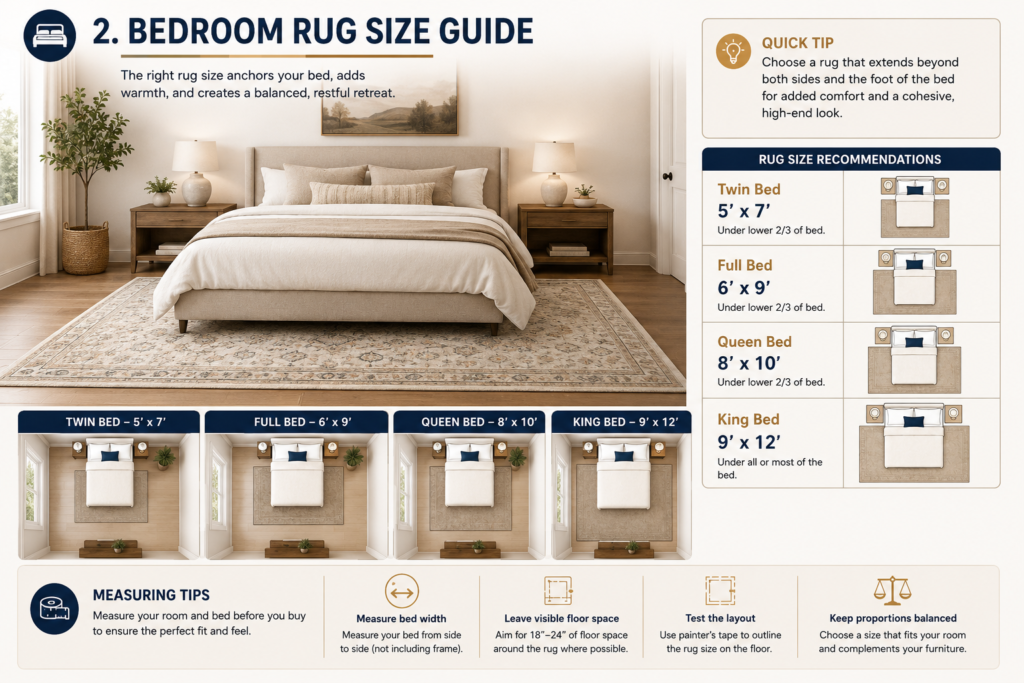
This bedroom rug size guide helps you choose dimensions for twin, full, queen, and king beds.
Rug Size for a Twin Bed
A 5 × 7 ft rug can work well beneath a twin bed.
Position it under the lower two-thirds of the bed so part of the rug extends beyond the foot and sides.
Another option is to place a runner along one side of the bed.
Rug Size for a Full Bed
A 6 × 9 ft rug can work beneath a full bed in a compact bedroom.
An 8 × 10 ft rug provides more coverage and creates a more comfortable landing area around the bed.
Rug Size for a Queen Bed
An 8 × 10 ft rug is a popular choice for a queen bed.
Place the rug beneath the lower two-thirds of the bed. It should extend approximately 18 to 24 inches beyond both sides and the foot.
In a larger bedroom, a 9 × 12 ft rug can also accommodate the bed and nightstands.
Rug Size for a King Bed
A 9 × 12 ft rug is generally suitable for a king bed.
A 10 × 14 ft rug may be better when you want the bed, nightstands, and bench to sit within one defined area.
Use this rug size guide to compare the bed width with the rug width before ordering.
For a warm and peaceful bedroom, explore these warm minimalism decor ideas.
Alternative Bedroom Rug Placement
You do not always need one large rug beneath the bed.
You can also use:
- One runner on each side of the bed
- One runner at the foot of the bed
- Two matching rugs beside the bed
- One small rug beneath a bedroom bench
This approach can provide comfort without covering most of the floor.
4. Dining Room Rug Size Guide
A dining room rug must be large enough to accommodate both the table and the chairs.
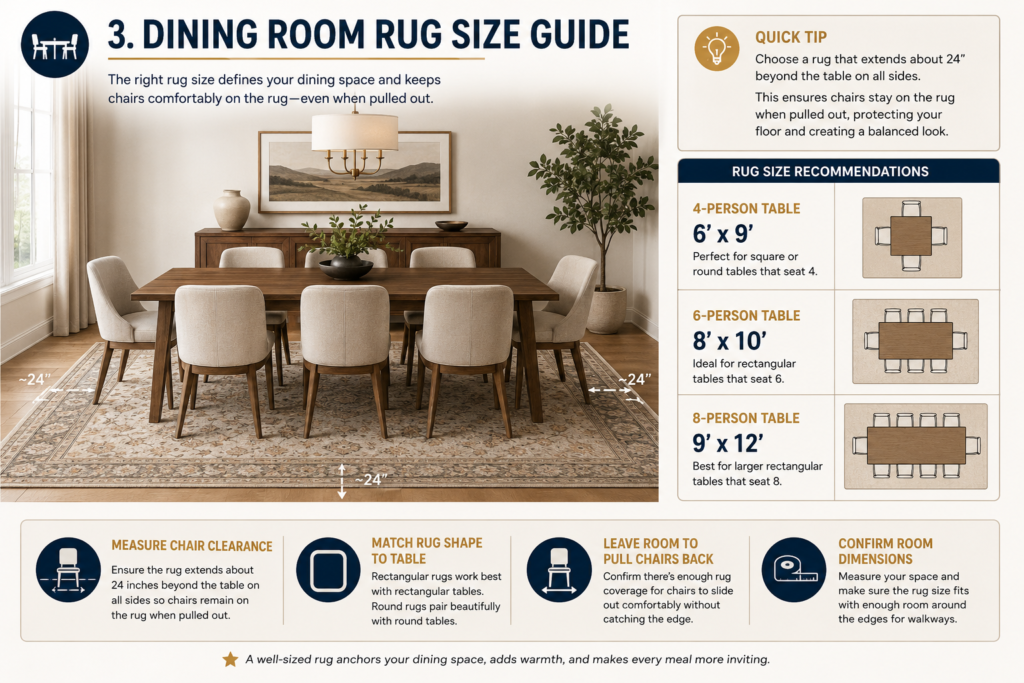
Following a dining room rug size guide is important because chairs move backward whenever someone sits down or stands up.
All four chair legs should remain on the rug when the chair is pulled away from the table.
As a general starting point, choose a rug that extends approximately 24 inches beyond every side of the dining table.
Rug Size for a Four-Person Table
A 6 × 9 ft rug can work beneath a compact four-person dining table.
Measure the table with the chairs pulled out before choosing the final rug size.
Rug Size for a Six-Person Table
An 8 × 10 ft rug is often suitable for a rectangular dining table with six chairs.
This size usually gives the chairs enough space to move without catching on the rug’s edges.
Rug Size for an Eight-Person Table
A 9 × 12 ft rug can work well beneath a large table with six to eight chairs.
For a particularly large dining area, consider a 10 × 14 ft rug.
Use this dining room rug size guide to ensure the table and chairs fit comfortably within the rug’s boundaries.
For another helpful reference, visit Lowe’s guide to choosing an area rug.
Match the Rug Shape to the Table
Choose a rug shape that complements the dining table:
- Rectangular table: rectangular rug
- Round table: round or square rug
- Square table: square or round rug
- Oval table: rectangular or oval rug
The rug shape should also work with the dimensions of the room.
5. Rug Size Guide for a Round Dining Table
For a round dining table, the rug should be wide enough to keep the chairs on the rug when they are pulled back.
Use these common combinations as starting points:
- 36-inch table: 6-foot round rug
- 48-inch table: 8-foot round rug
- 60-inch table: 9-foot round rug
- 72-inch table: 10-foot round rug
This rug size guide uses general measurements, but the depth of your chairs can affect the final size.
Before ordering, mark the rug dimensions on the floor and test the chair movement.
6. Hallway Runner Rug Size Guide
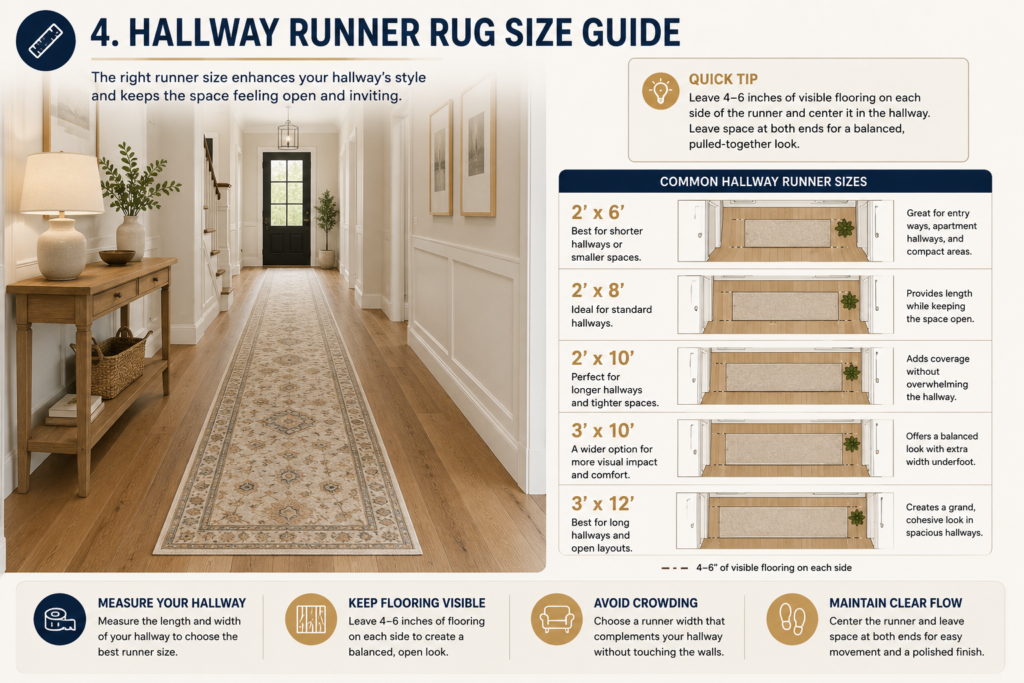
A hallway runner should follow the length of the space without completely covering the floor.
This hallway rug size guide recommends leaving approximately 4 to 6 inches of visible flooring on each side of the runner.
Common runner sizes include:
- 2 × 6 ft
- 2 × 8 ft
- 2 × 10 ft
- 3 × 10 ft
- 3 × 12 ft
Choose a runner that leaves some visible space at both ends of the hallway.
Keep nearby furniture completely on or completely off the runner. Avoid placing a console table halfway across the rug’s edge.
7. Entryway Rug Size Guide
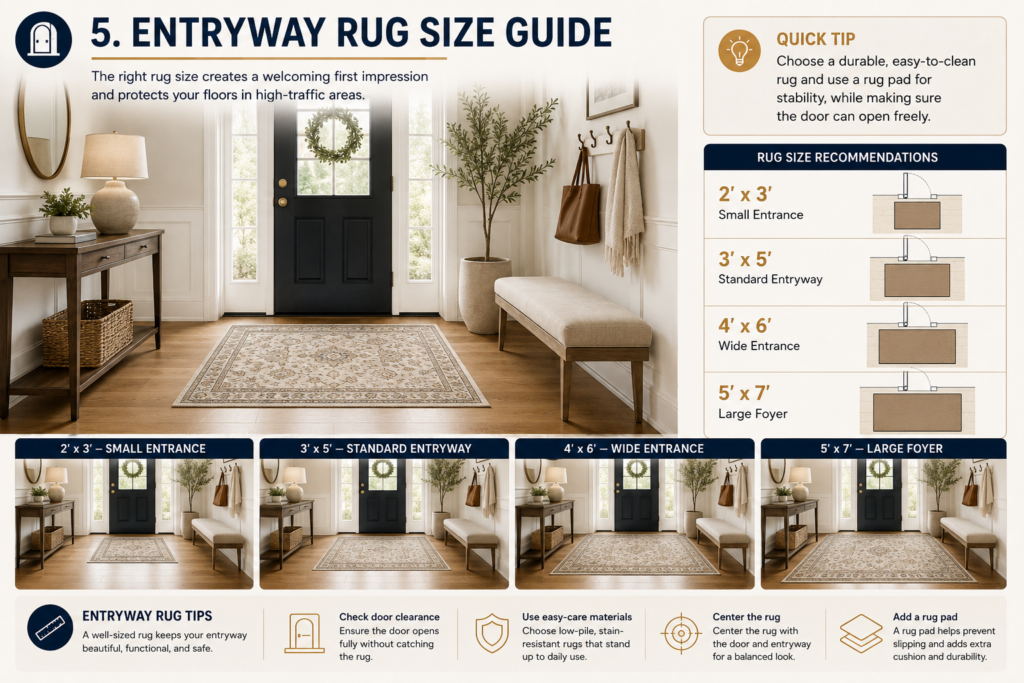
An entryway rug should be practical, durable, and proportional to the entrance.
Use this entryway rug size guide as a starting point:
- 2 × 3 ft for a small entrance
- 3 × 5 ft for a standard entryway
- 4 × 6 ft for a wider entrance
- 5 × 7 ft for a large foyer
Make sure the rug is thin enough for the door to open freely.
For a busy entrance, choose a material that is easy to clean and resistant to moisture.
A nonslip rug pad can help prevent movement and protect the floor underneath.
For a brighter and calmer color palette, explore these aquamarine home decor ideas.
8. Home Office Rug Size Guide
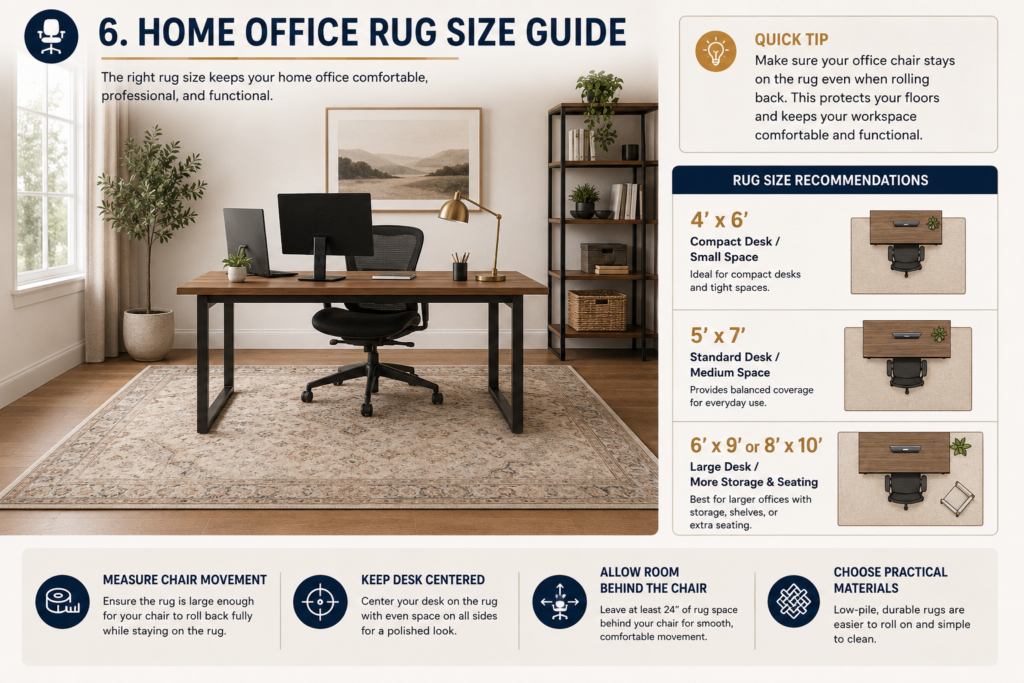
A home office rug should define the work zone while allowing the chair to move comfortably.
A 4 × 6 ft or 5 × 7 ft rug may be suitable for a compact desk.
A 6 × 9 ft or 8 × 10 ft rug provides more room for:
- A large desk
- An office chair
- Storage furniture
- Guest chairs
- A reading corner
Ideally, the desk and chair should both sit on the rug.
This home office rug size guide recommends leaving enough rug behind the chair so it does not roll off the edge when you move backward.
9. Rug Size Guide for an Open-Concept Space
In an open-concept home, rugs can visually separate different functional areas.
You can use:
- One rug to define the living area
- Another rug beneath the dining table
- A runner between the kitchen and hallway
- A small rug for a reading corner
- A separate rug beneath a desk
Use the same rug size guide principles for each zone separately.
The rugs do not need to match exactly. However, they should share at least one common element, such as:
- Color
- Texture
- Material
- Pattern
- Design style
Avoid placing several rugs too close together. Each rug should clearly define its own area.
10. Make a Small Room Look Bigger With a Rug
A common misconception is that a small room always needs a small rug.
In many cases, a larger rug makes the room feel more spacious because it creates one continuous visual area.
Use these tips:
- Place at least the front furniture legs on the rug.
- Choose light or neutral colors.
- Use subtle patterns instead of extremely busy designs.
- Position the rug in the same direction as the room.
- Avoid using several tiny rugs in one space.
- Leave a consistent border of visible flooring.
This rug size guide recommends choosing the largest rug that fits comfortably without touching the walls.
11. Choose the Right Rug Material
The dimensions are important, but the material should also match the room’s function.
Wool Rugs
Wool rugs are soft, durable, and suitable for living rooms and bedrooms.
They are a good choice when comfort and longevity are priorities.
Cotton Rugs
Cotton rugs are often lightweight and suitable for casual rooms.
Some cotton rugs are easier to clean than heavier natural-fiber options.
Jute and Natural-Fiber Rugs
Jute rugs add warmth and texture.
They pair well with:
- Neutral colors
- Wood furniture
- Coastal interiors
- Rustic rooms
- Organic modern spaces
- Warm minimalist decor
Synthetic Rugs
Synthetic rugs can be practical in high-traffic rooms and homes with children or pets.
They are often easier to maintain than delicate natural-fiber rugs.
Washable Rugs
Washable rugs can work well in entryways, dining rooms, kitchens, and other areas where spills are common.
Indoor-Outdoor Rugs
For a patio, balcony, porch, or deck, choose a rug designed for outdoor conditions.
Discover these best outdoor rugs under $100 for affordable outdoor decorating ideas.
12. Avoid Common Rug Size Mistakes
Even when using a detailed rug size guide, the room can still look unbalanced if you ignore furniture placement.
Avoid these common mistakes.
Choosing a Rug That Is Too Small
A small rug can make the furniture look scattered.
When choosing between two sizes, the larger option often creates a more connected arrangement.
Measuring Only the Room
Measure the sofa, chairs, bed, table, desk, and walking paths in addition to the room.
Ignoring Door Clearance
A thick rug can prevent a door or cabinet from opening correctly.
Placing the Rug Too Close to the Wall
An area rug should not usually cover the floor like wall-to-wall carpet.
Leave a visible border around the rug to create contrast and balance.
Choosing the Wrong Rug Shape
Select a rug shape that complements both the furniture and the room.
A round rug works well beneath a round table, while a rectangular rug often suits a long living room.
Forgetting the Rug Pad
A suitable rug pad can prevent movement, add comfort, and protect the floor.
Choose a pad that is slightly smaller than the rug so it does not show around the edges.
Following this rug size guide will help you avoid undersized rugs and create a more cohesive furniture arrangement.
Final Rug Size Checklist
Before ordering your rug, review this rug size guide checklist:
- Measure the room accurately.
- Measure the furniture arrangement.
- Mark the rug outline with painter’s tape.
- Check doors, cabinets, and floor vents.
- Leave enough space for dining chairs.
- Confirm the office chair can move freely.
- Choose a shape that complements the room.
- Select a material suitable for the traffic level.
- Check cleaning and maintenance requirements.
- Use an appropriate rug pad.
- Confirm the final dimensions before ordering.
Frequently Asked Questions
What Is the Most Common Living Room Rug Size?
According to this rug size guide, an 8 × 10 ft rug is a common choice for a medium-sized living room.
It usually allows the front legs of the sofa and chairs to sit on the rug.
Should a Rug Go Under a Sofa?
A rug should ideally extend beneath at least the front legs of the sofa.
In a large living room, all the sofa and chair legs can sit on the rug.
Is a 5 × 7 Rug Too Small for a Living Room?
A 5 × 7 ft rug can work in a compact room.
However, it may look too small when placed with a large sofa, sectional, or several chairs.
How Far Should a Rug Extend Beyond a Dining Table?
A rug should provide enough room for the chairs to remain on it when they are pulled away from the table.
A common starting point is approximately 24 inches beyond each side of the table.
What Rug Size Is Best for a Queen Bed?
This rug size guide recommends an 8 × 10 ft rug as a common starting point for a queen bed.
A 9 × 12 ft rug can provide more coverage in a larger room.
What Rug Size Is Best for a King Bed?
A 9 × 12 ft rug is usually suitable for a king bed.
A 10 × 14 ft rug can work better when you want more floor coverage.
Can a Rug Be Wider Than a Sofa?
Yes. A rug that extends beyond both sides of the sofa can make the room feel balanced and spacious.
Do Rugs Make Rooms Look Bigger?
A properly sized rug can make a room feel larger by connecting the furniture and creating one cohesive visual zone.
A rug that is too small can make the space feel divided.
Conclusion
Choosing the right rug becomes easier when you follow a practical rug size guide, measure your furniture carefully, and visualize the layout before placing an order.
Use this rug size guide to compare standard dimensions and avoid choosing a rug that feels too small or disconnected from the room.
The best rug should connect the furniture, complement the room’s proportions, and provide enough visible flooring to create balance.
Bookmark this rug size guide so you can return to the measurements whenever you decorate a living room, bedroom, dining room, hallway, entryway, or home office.